When a faster sign-up method backfires, the fix usually isn’t the button. It’s the assumptions users bring with them.
Project Overview
Shortly before I joined BETFAN, the company introduced bank-based registration via mojeID as a faster alternative to the platform’s standard sign-up flow. It didn’t perform the way anyone hoped. I led the research that uncovered why, and the redesign that followed, turning a flow users were abandoning into one that meaningfully outperformed the classic registration path.
Context and My Role
As Senior Product Designer at BETFAN, I took full responsibility for the app’s product design, including planning and running user research. The bank-based registration flow was already live when I arrived, before my time at the company. My work here started with diagnosing why it wasn’t working, not with the original design decision.
It’s worth noting the context in which this sits: licensed betting platforms in Poland operate under identity-verification requirements, so registration isn’t a simple email-and-password form. It has to distinguish between a fully verified account and a temporary, unverified one, and it has to get users through identity verification without losing them along the way. That constraint shapes everything about this flow.
The Problem
We ran a broad survey to understand why so few people were completing bank-based registration, yielding 100–200 responses. The answers were full of surface-level complaints: “no Revolut support,” “worried about data theft,” and similar. “Add Revolut” wasn’t actually something we could act on. Which banks appeared in that flow was entirely controlled by our mojeID provider, not something we could configure on our end. So even the survey’s most common, most concrete-sounding complaint pointed nowhere we could actually go. That in itself was a signal: whatever was driving the drop-off had to be something else.
I proposed something more targeted: in-depth interviews with a small group of real users (three participants) to understand what was actually happening when someone hit that screen, rather than relying on what they said they wanted afterwards.
What the Interviews Actually Found
The interviews reframed almost everything the survey suggested:
“Revolut” wasn’t really about Revolut.
It was the most frequently cited example of a broader, more common problem: “my bank isn’t on this list” (several participants mentioned Ukrainian banks, for instance). Since the list of supported banks was fixed by our mojeID provider either way, the real question wasn’t which bank was missing — it was how to help people who’d hit that wall in the first place.
It was the most frequently cited example of a broader, more common problem: “my bank isn’t on this list” (several participants mentioned Ukrainian banks, for instance). Since the list of supported banks was fixed by our mojeID provider either way, the real question wasn’t which bank was missing — it was how to help people who’d hit that wall in the first place.
Users didn’t understand what mojeID was.
Several expected something closer to a photo ID verification app, not a bank login-based identity method.
Several expected something closer to a photo ID verification app, not a bank login-based identity method.
The mechanism itself was unfamiliar in the moment.
Once inside the flow, people realised it meant logging into their bank account — something they recognised, but not every bank supported it, so they dropped out.
Once inside the flow, people realised it meant logging into their bank account — something they recognised, but not every bank supported it, so they dropped out.
A serious, and revealing, misconception about data security.
Some participants believed they were handing their banking login credentials directly to BETFAN, rather than authenticating with their bank the way they always would. That fear wasn’t irrational — it echoes exactly the kind of warning banks themselves put out in anti-fraud campaigns. The flow hadn’t done anything to distinguish itself from what a scam attempt would look like.
Some participants believed they were handing their banking login credentials directly to BETFAN, rather than authenticating with their bank the way they always would. That fear wasn’t irrational — it echoes exactly the kind of warning banks themselves put out in anti-fraud campaigns. The flow hadn’t done anything to distinguish itself from what a scam attempt would look like.
A mundane but very real blocker: forgotten credentials.
Many people log into their banking app once and never again, relying on biometrics or a saved session afterwards. When the flow required them to actively recall a username and password, several simply couldn’t, and assumed they’d just get an in-app approval prompt instead.
Many people log into their banking app once and never again, relying on biometrics or a saved session afterwards. When the flow required them to actively recall a username and password, several simply couldn’t, and assumed they’d just get an in-app approval prompt instead.
Some users just preferred the classic sign-up.
Not everyone wanted a shortcut. Some were more comfortable with a registration method they’d used for years.
Not everyone wanted a shortcut. Some were more comfortable with a registration method they’d used for years.
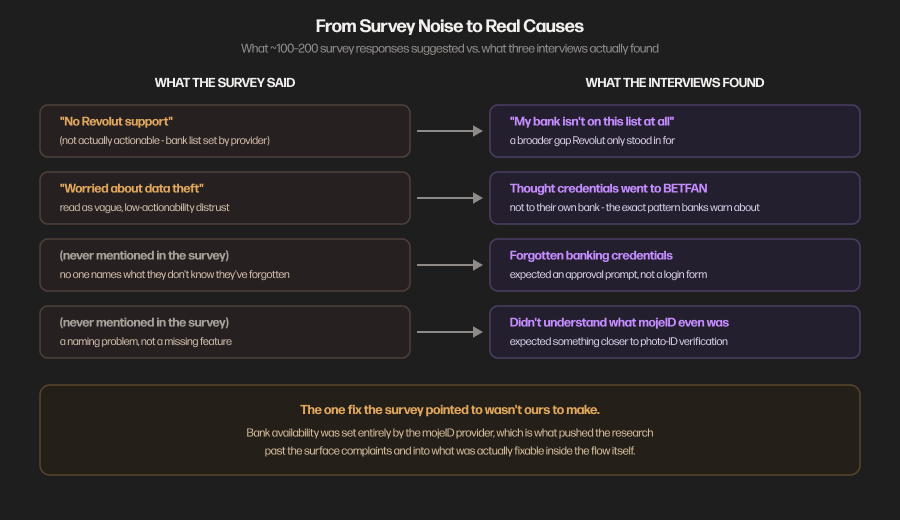
What the survey suggested vs. what three interviews actually found underneath each complaint.
Design Response
Rather than treating this as a labelling or bank-list problem, I designed an intermediate step that sat between choosing “register via your bank” and the actual bank redirect — directly addressing what the interviews surfaced:
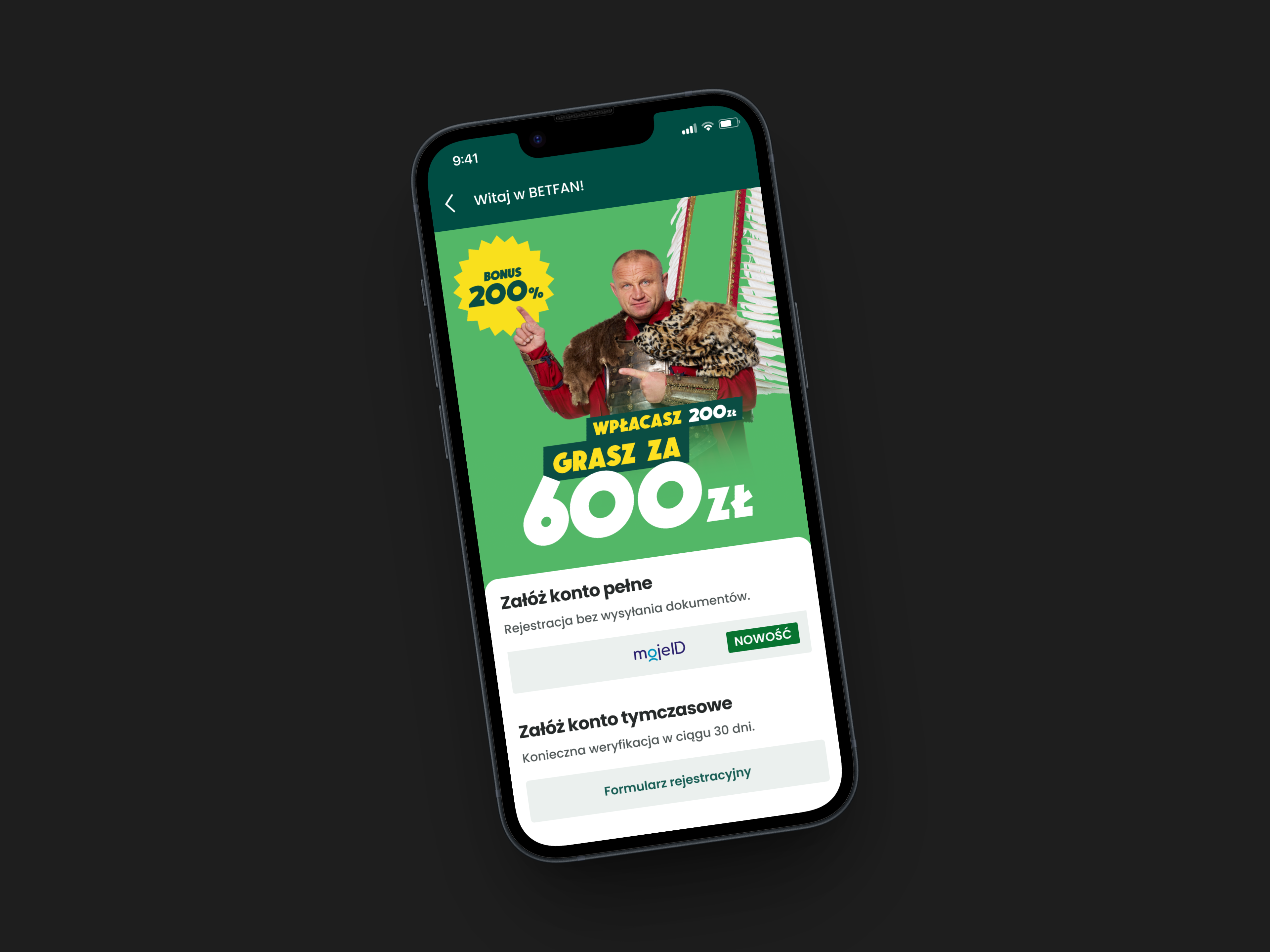
The inherited flow: tapping a MojeID logo led straight to a grid with bank selection, with no context on what mojeID was, which accounts it applied to, or what happened to the data.
• Clear up-front distinction between a full (verified) account and a temporary, unverified one, so the trade-off was explicit before committing.
• Only the banks we actually supported were shown, removing ambiguity about whether a user’s bank would work.
• A direct prompt to have banking login details ready, addressing the “I don’t remember my password” drop-off point before it happened.
• Explicit reassurance that login credentials go straight to the user’s own bank, not to BETFAN - directly countering the security misconception the interviews uncovered.
• The classic registration path stayed one tap away the entire time, for anyone who changed their mind or preferred it from the start.
One detail worth calling out: interviews showed people instinctively wanted to tap directly on their bank’s logo to start the process. Deep-linking straight into a specific bank’s flow from that point wasn’t technically feasible, so instead I made each bank logo function as an active element equivalent to the main “Register via your bank” button, matching the behaviour users expected, even where the underlying technical shortcut wasn’t possible.
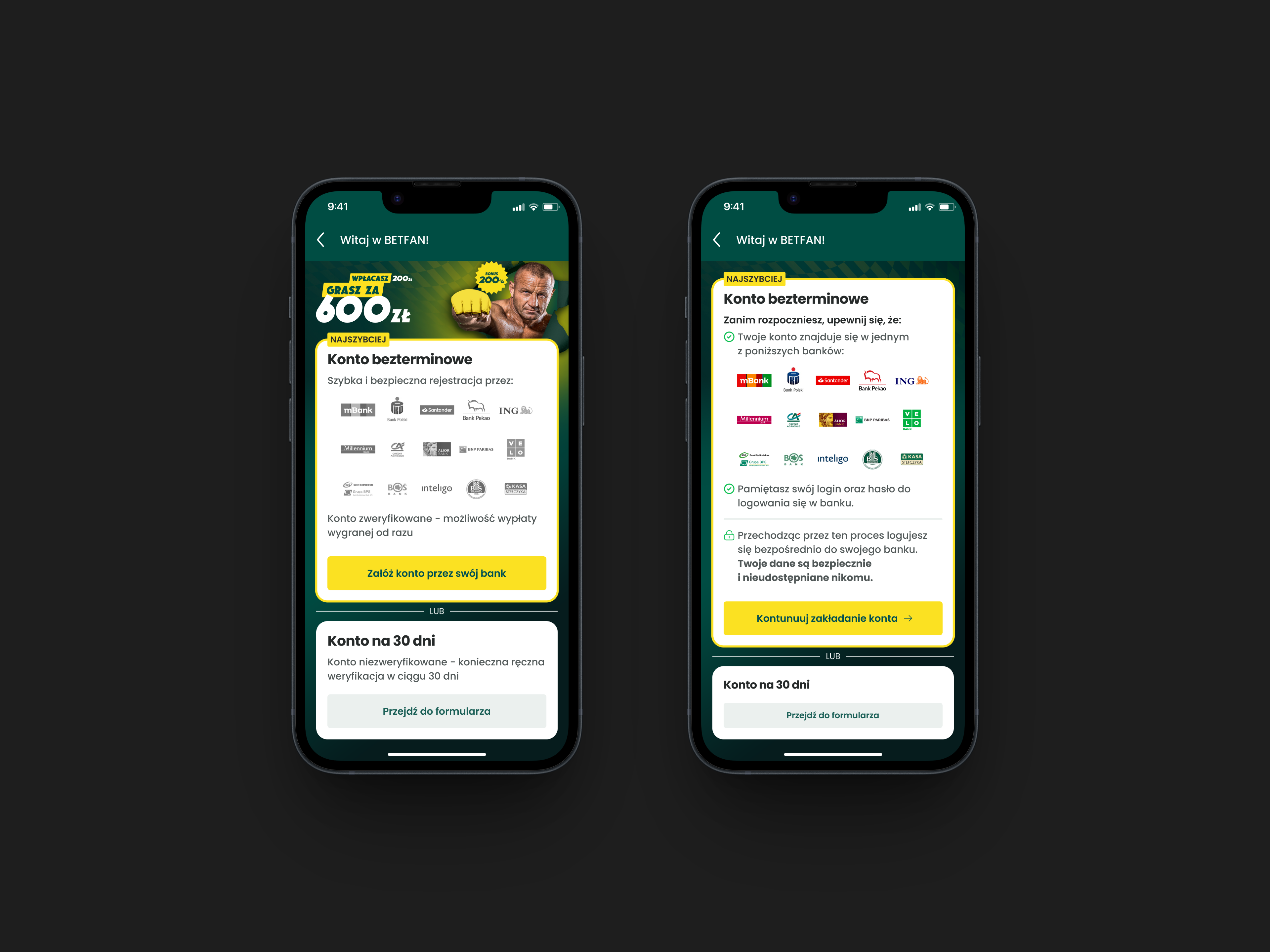
The new intermediate step, split across two screens: first clarifying account types and showing only supported banks, then reassuring users their credentials go directly to their own bank before they continue.
Outcome
Following an A/B test, the redesigned flow showed a clear improvement in overall completion, and abandonment at the very first step (the bank-selection screen) was practically eliminated. Just as importantly, the flow converted people into fully verified accounts at a qualitatively better rate than classic registration, which still required a separate verification step afterwards. I don’t have exact figures to cite, but the shift was clear enough, on both metrics, to confirm the interview findings had identified the real problems.
Key Learnings
Survey answers describe symptoms, not causes.
“Add Revolut” wasn’t even an option within our control, which forced us to look past it — and what we found underneath was a much broader “my bank isn’t listed” gap, tangled up with a fundamental misunderstanding of what the flow even was. None of that would have surfaced without sitting down with a handful of real users.
“Add Revolut” wasn’t even an option within our control, which forced us to look past it — and what we found underneath was a much broader “my bank isn’t listed” gap, tangled up with a fundamental misunderstanding of what the flow even was. None of that would have surfaced without sitting down with a handful of real users.
Security fears are often a mental-model problem, not a trust problem.
Users weren’t wrong to be cautious. They were reacting to a flow that, from their side, looked exactly like the credential-harvesting pattern their own bank warns them about. The fix wasn’t “explain that it’s safe” in the abstract; it was addressing the specific point of confusion driving the fear.
Users weren’t wrong to be cautious. They were reacting to a flow that, from their side, looked exactly like the credential-harvesting pattern their own bank warns them about. The fix wasn’t “explain that it’s safe” in the abstract; it was addressing the specific point of confusion driving the fear.
Give people an exit, even when you’re confident in the new path.
Keeping classic registration visible and available throughout wasn’t a hedge against the redesign failing. It respected that some users simply wouldn’t want the shortcut, and forcing them to use it would have cost more than it gained.
Keeping classic registration visible and available throughout wasn’t a hedge against the redesign failing. It respected that some users simply wouldn’t want the shortcut, and forcing them to use it would have cost more than it gained.